
My Music Year
Printable pages for violin and viola students in kindergarten and first grade, a page a week for a school year: the beat, the instrument and bow, rhythm, and first notes, in large print.
40 pages · US Letter · PDF, 2.2 MB. Free, with no email or sign-up.
Print makes the workbook alone, the same as the PDF. Your browser’s print window can also save it as a PDF.
To print the workbook itself, use the Print the workbook button on this page, or download the PDF.
A look inside
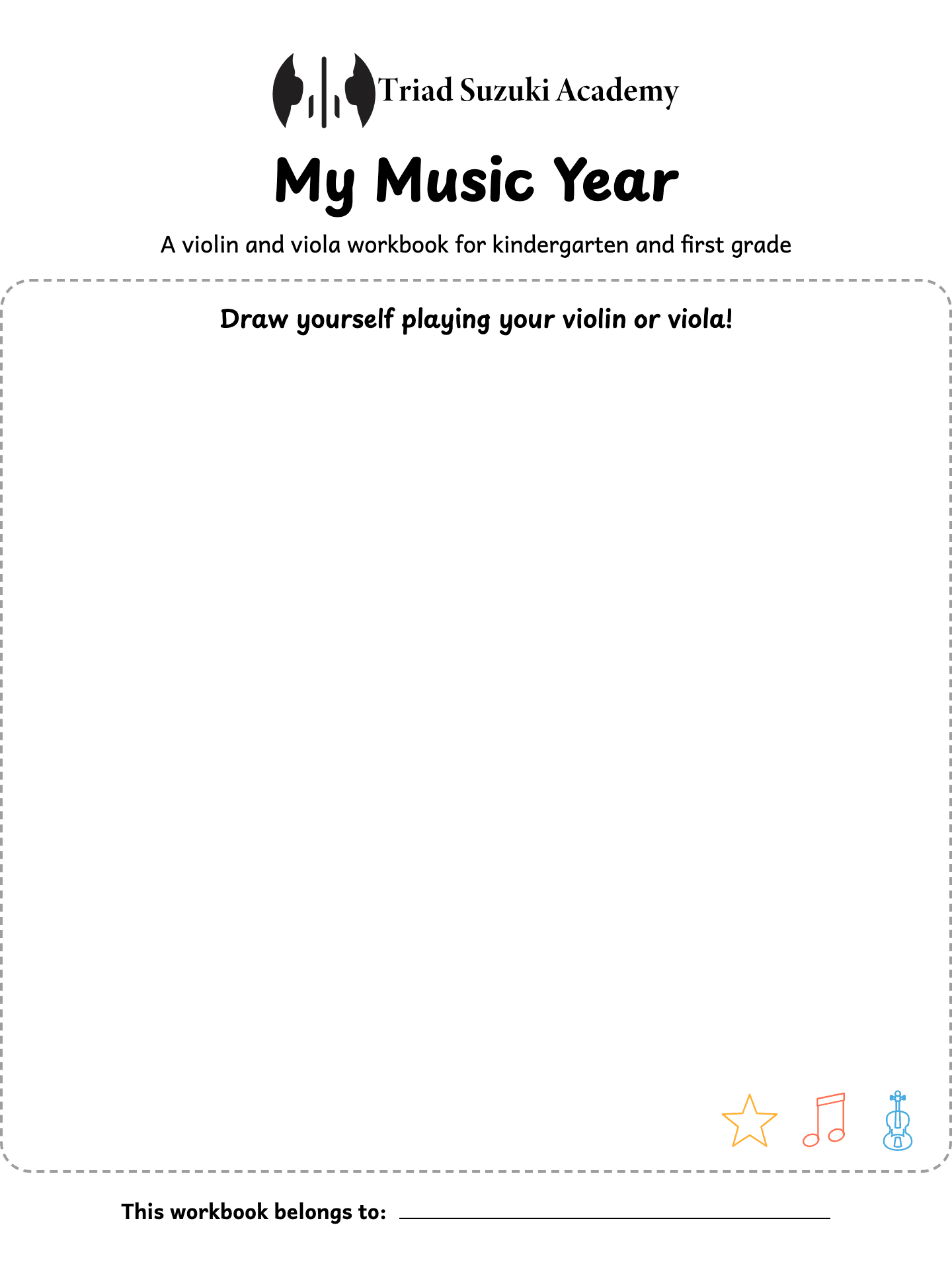
The cover, page 1 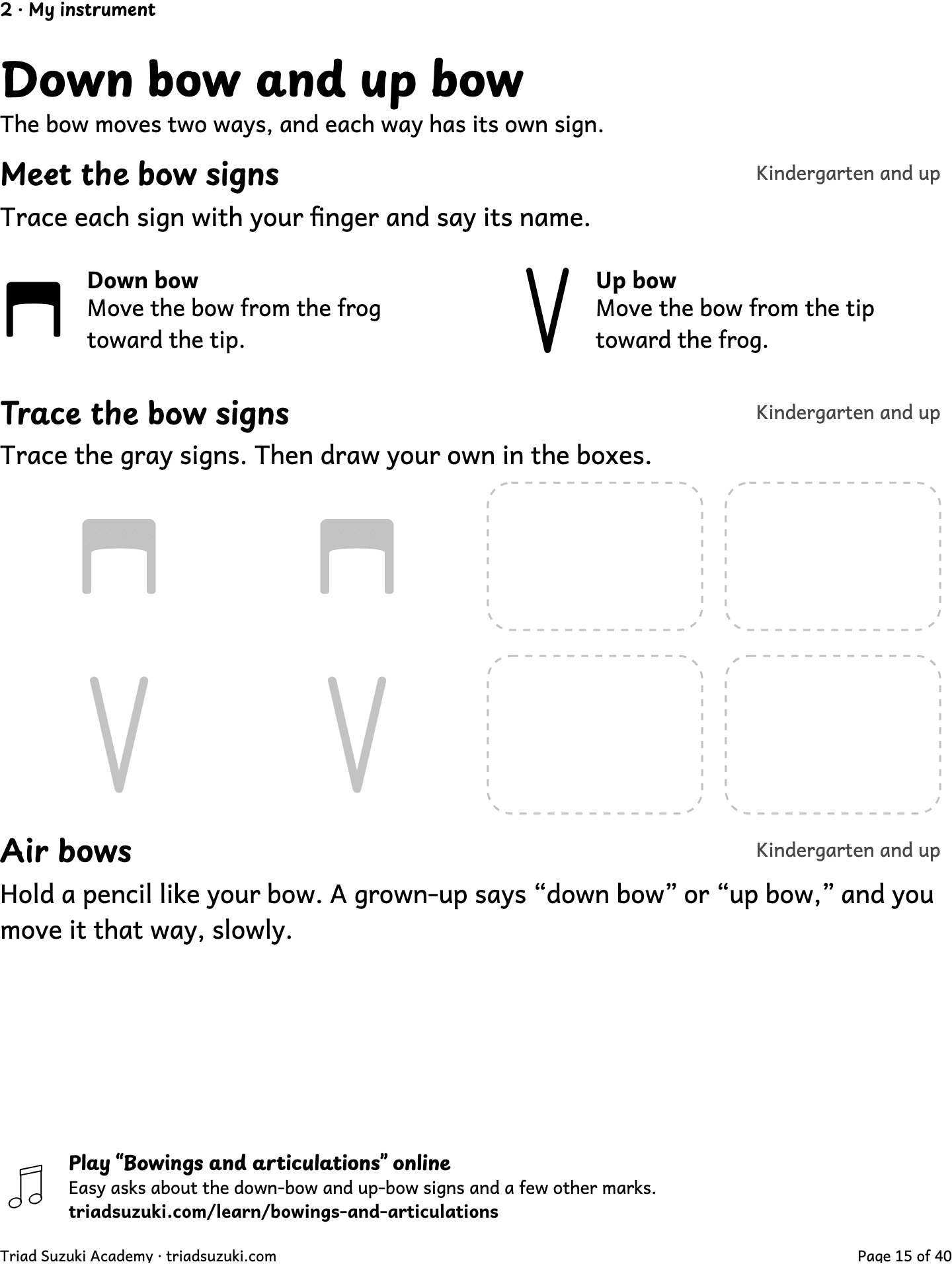
Section 2: the bow signs, page 15 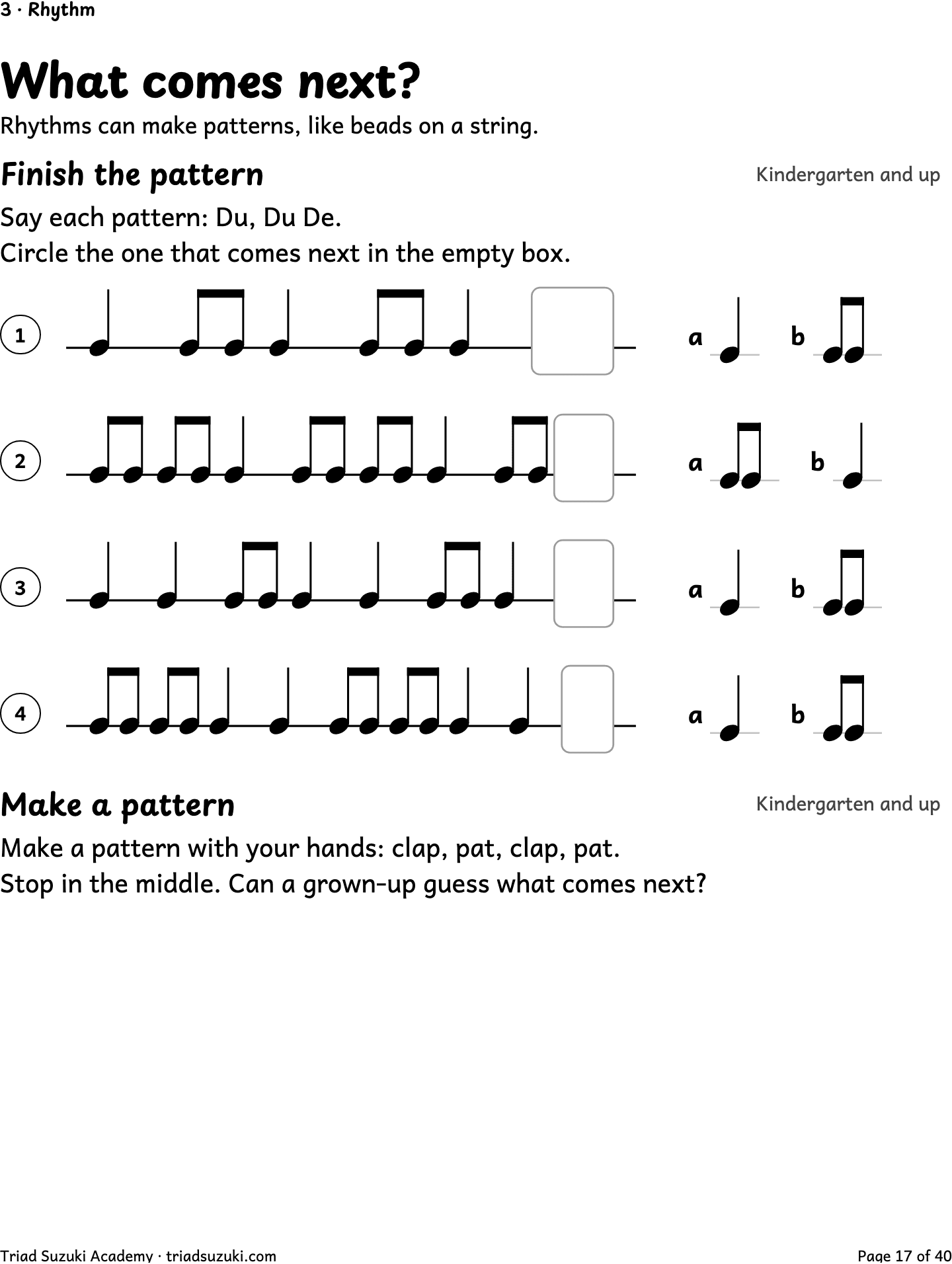
Section 3: rhythm patterns, page 17 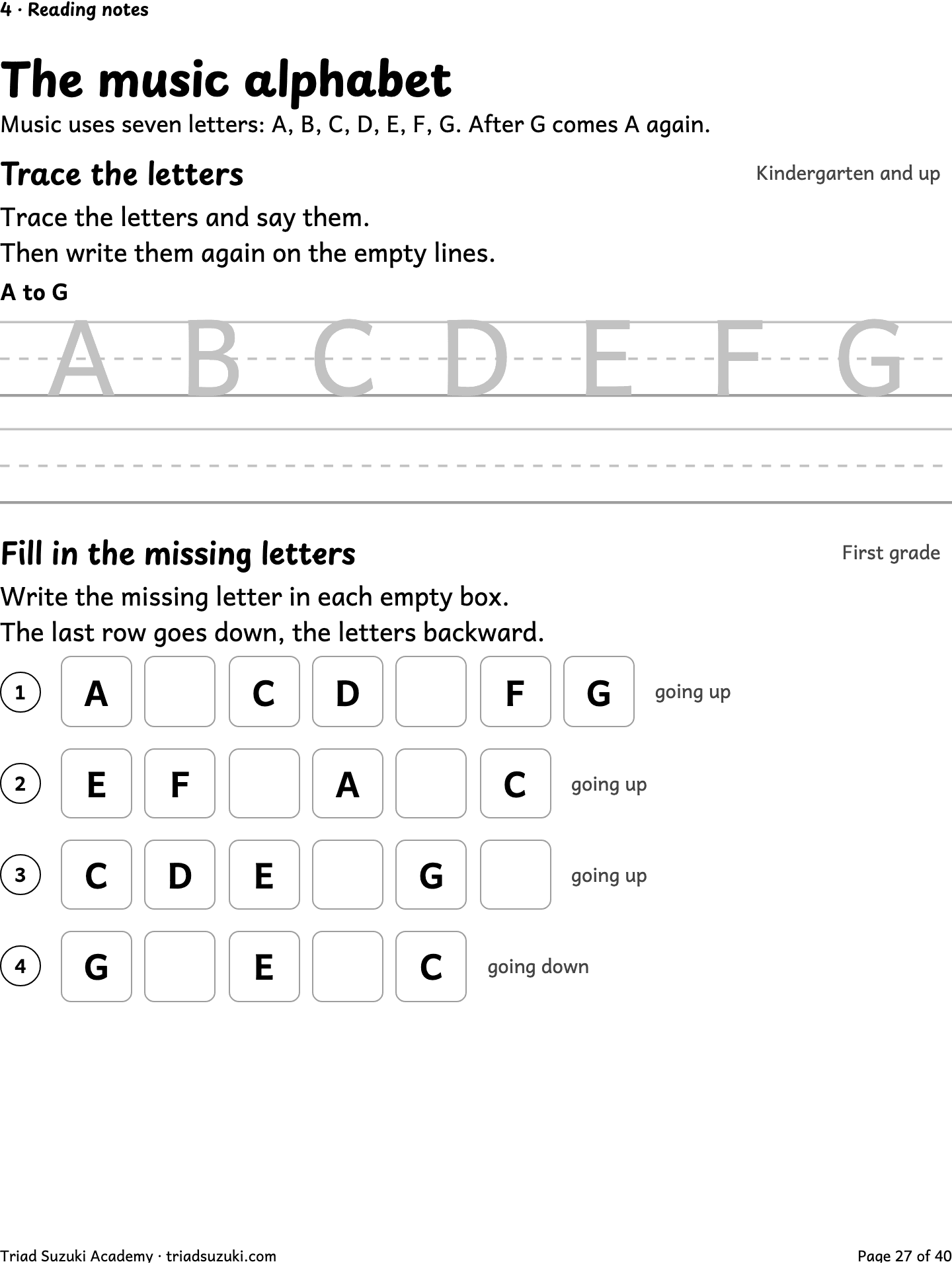
Section 4: the music alphabet, page 27
What is inside
- 1. Listen and move (pages 3 to 9). Feel the steady beat, and hear high and low, loud and soft, fast and slow, and same and different.
- 2. My instrument (pages 10 to 15). The parts of the violin and viola, taking care of them, the strings, the finger numbers, getting ready to play, and the bow.
- 3. Rhythm (pages 16 to 23). Rhythm is how long each note lasts. Say it, clap it, then play it.
- 4. Reading notes (pages 24 to 32). The staff, steps and skips, the music alphabet, and the clef, strings, and first notes for your instrument.
- 5. Practice and play (pages 33 to 36). Listening every day, a week of practice to color in, a tune of your own, and a concert at home.
It ends with an answer key and a page to celebrate. Download all 40 pages.
Who it is for
Violin and viola students in kindergarten and first grade. It starts where our beginner workbook starts, told again for children learning to read, with pages on the instrument and the bow added: fewer words, large print, and one to three activities to a page.
There are 34 pages of activities, so a page a week lasts about a school year. Each activity is marked kindergarten or first grade, and the answers are at the back.
Violinists do the treble clef activities and violists the alto clef ones. Where a page has one of each, your child does the one for their instrument.
Teachers may copy it for a kindergarten, first grade, or homeschool class. Music teachers, please ask us first.
Free online games and classes to go with it
Many pages of the workbook name a free game or class on our site that practices the same thing. They work on a phone, tablet, or computer, with nothing to sign up for.
Free class · Section 1
Dynamics
Play with volume and feeling: piano and forte, the crescendo, accents, and why dynamics are always relative.
Free class · Section 1
Tempo
The speed of the beat: Italian tempo words, metronome marks, and how music speeds up, slows down, and pauses.
Free game · Section 2
Bowings and articulations
A mark appears on the staff and you choose what it tells you to do, or you count the bows in a short passage. From a first down-bow to trills and harmonics.
Free class · Section 3
Rhythm
Learn to read rhythm from the ground up: the beat, note values and rests, beaming, dotted notes, and counting a bar out loud.
Free game · Section 3
How long is that note?
A note, a rest, or a pair of tied notes appears, and you work out how long it lasts. From a long whole note down to the quickest thirty-seconds.
Free class · Section 4
The Staff
The basics of reading music: the five lines and four spaces, high and low on the staff, and why every staff needs a clef.
Free class · Section 4
Treble Clef
Learn to read the treble clef from scratch: the G line, lines and spaces, reading on sight, and handy mnemonics.
Free class · Section 4
Alto Clef
Learn to read the alto clef from scratch: middle C on the center line, the lines and spaces, reading on sight, and the anchor that does the work a mnemonic would.
Free game · Section 4
Name that note
A note appears on the staff and you name it, in the treble, bass, or alto clef. Harder levels add ledger lines, sharps, and flats.
Free game · Section 4
Where's that note?
A note appears on the staff and you find where it is played on a violin or viola, or a spot is marked and you name its note. From the Twinkle strings to every finger in first position.
Lessons in Kernersville
When your child is ready for more, come meet us. Book a free 30-minute trial lesson at our studio in Kernersville, North Carolina, at the heart of the Triad.