
For most families, the hard part of violin practice is not the practice itself. It is remembering to do it every day, in a week that is already full. The good news is that daily practice can become a habit: something your family does at the same point in the day, without having to decide each time.
This guide covers how a habit forms, how to fit practice into your day, how a practice chart helps, and what research says about prizes. At the end are two free charts you can print.
How a habit forms
Psychologists who study habits have found that doing the same thing in the same situation, again and again, is what makes it automatic. In time, the situation itself brings the action to mind, and nobody has to decide.
You may have heard that a habit takes 21 days. The research suggests longer. In one well-known study, 96 volunteers chose something to eat, drink, or do every day at the same point in their day, such as after breakfast. It took a median of about 66 days for the new habit to feel automatic, and the time varied a lot from person to person, from 18 to 254 days. Missing a single day did not undo their progress.
The volunteers were adults, and their habits were simpler than playing the violin, so take the numbers as a rough guide. For a family, the lesson is to expect a couple of months before practice feels like part of the day. Until then, the parent is the one who remembers, and a missed day is no reason to stop.
Tie practice to something you already do
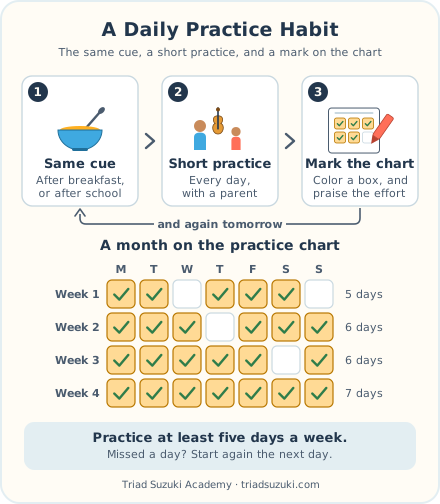
The easiest cue is a moment that already happens every day. Habit researchers suggest a cue within an existing daily routine, at a time and place you meet every day of the week. For a family, that might be:
- Right after breakfast, before school.
- When you get home from school, after a snack.
- Right after dinner, before any screens.
Then say the plan in a when-then form: "After breakfast, we practice violin." Researchers call this an if-then plan. A review of 94 tests found that plans like this had a medium-to-large effect on whether people reached their goals. Write the plan on your chart, where everyone can see it.
Keep it short, and do it every day
A habit grows from repetition, so the daily part matters more than the length. Dr. Suzuki's institute in Japan asks, "Why is it necessary to practice every day?" Its answer is that memory develops every day, through constant repetition and positive reinforcement. Our studio asks for practice at least five days a week.
How long to practice depends on your child's age and attention. Practice Makes Progress has more on short, focused sessions, and Practicing the Way Memory Works explains why spreading practice across days helps it last.
How to use a practice chart
A practice chart is a record of the days your child practiced. It shows the habit growing, and it gives your child one last small step to finish each practice.
Research supports keeping a record. A review of 138 studies found that monitoring progress toward a goal helped people reach it, and it helped more when progress was written down or shared with someone. In a guide for family doctors, three habit researchers suggest keeping a daily tick-sheet while forming a new habit, until it becomes automatic.
Some ways to make a chart work:
- Mark it right after practice. The mark becomes the last step of the routine, and your child gets to make it.
- Keep it where you both see it. On the fridge or the music stand, it reminds everyone and shows the week at a glance.
- Bring it to lessons. Your teacher sees how the week went, and your child gets to show their work.
- Count the days, not the gaps. If your child misses a day, start again the next day. In the habit study, one missed day did not undo the progress.
Praise the effort, and go easy on prizes
Many charts come with prizes: a sticker for every day, a toy for a full week. Research suggests caution. A review of experiments on rewards found that prizes promised in advance for doing something enjoyable tended to lower people's own interest in it, and the effect was stronger in children than in college students. Surprise treats did not have that effect.
So let the chart be a record you celebrate together, not a deal for a prize. When you praise, praise the work: "You kept going on that hard spot." In a well-known set of studies with fifth graders, children praised for their effort kept at a task longer after a setback than children praised for being smart. The Parent's Guide to Supporting Young Violinists has more on encouragement.
Two free charts to print
We made two practice charts you can print at home.
- The weekly practice chart has a line for each day: whether your child listened to the recordings, how many minutes they practiced, what they worked on, and your initials.
- The coloring practice chart is for our youngest violinists. They color in a shape for every 10 minutes of practice, with a different shape for each day.
Print one, write your when-then plan on it, and put it where you will both see it tomorrow. If you would like help with your child's practice routine, we are happy to talk.
Sources
- How are habits formed: Modelling habit formation in the real world (opens in a new tab), a study by Phillippa Lally and colleagues, European Journal of Social Psychology, 2010
- Making health habitual: the psychology of 'habit-formation' and general practice (opens in a new tab), Benjamin Gardner, Phillippa Lally, and Jane Wardle, British Journal of General Practice, 2012
- Time to form a habit (opens in a new tab), a review by Ben Singh and colleagues, Healthcare, 2024
- Implementation intentions and goal achievement (opens in a new tab), a review by Peter Gollwitzer and Paschal Sheeran, 2006
- Does monitoring goal progress promote goal attainment? (opens in a new tab), a review by Benjamin Harkin and colleagues, Psychological Bulletin, 2016
- A meta-analytic review of experiments examining the effects of extrinsic rewards on intrinsic motivation (opens in a new tab), a review by Edward Deci, Richard Koestner, and Richard Ryan, Psychological Bulletin, 1999
- Praise for intelligence can undermine children's motivation and performance (opens in a new tab), a study by Claudia Mueller and Carol Dweck, Journal of Personality and Social Psychology, 1998
- The Basic Principles of the Suzuki Method (opens in a new tab), Talent Education Research Institute, Japan