
Families across the Triad often ask us how often their child should have music lessons. The answer depends on the student's age, commitment, and goals. Here is how we think about it.
How often should beginners have music lessons?
For beginners, we recommend one lesson every week. A week gives time to practice and absorb new material, and a regular lesson day becomes part of the family's routine.
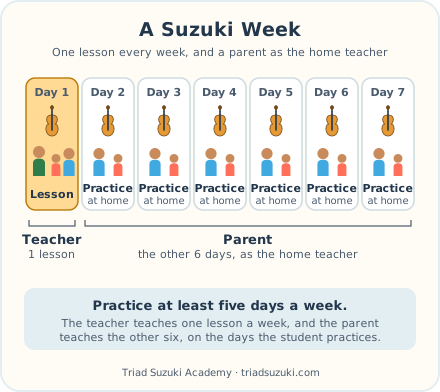
In the Suzuki method, a parent comes to lessons, practices with the child at home, and serves as the home teacher during the week. We like to say that the teacher teaches one lesson a week and the parent teaches the other six (on the days the student practices!). Our studio policy asks for practice at least five days a week.
Are weekly lessons more effective than biweekly lessons?
"Biweekly" can mean every two weeks or twice a week, and dictionaries list both.
Every two weeks. For beginners, we recommend weekly lessons, because in Suzuki teaching each new step comes from the teacher. Each skill is mastered before the next one begins, and parents wait for the teacher to guide them to it. With a lesson every other week, a beginner waits twice as long between new steps, and the teacher checks in on practice half as often.
Twice a week. In Suzuki programs, the second session of the week is often a group class: one individual lesson and one group lesson each week. Group Class is part of our program too; see our classes page.
As students advance, a second individual lesson each week can make sense for some of them, such as a student preparing for an audition, a playing test, or a performance. It gives more time for detail and quicker feedback on practice. If that sounds like your student, talk with us.
How do make-up lessons and rescheduling work?
Children get sick, and plans change. Here is how our studio policies handle missed lessons:
- Illness or a family emergency: we offer a make-up lesson when you give at least 24 hours' notice, up to two per semester. Make-ups are scheduled based on the teacher's availability.
- Late cancellations: a lesson cancelled with less than 24 hours' notice is not eligible for a make-up or a refund.
- If the teacher cancels: we schedule a make-up at a time that works for your family and the teacher.
- A one-time conflict: you may swap lesson times with another studio family for that week, so neither family misses a lesson.
What about after-school, evening, or weekend times?
Lesson times depend on our openings each semester. If you need a particular day or time, ask about current openings when you register. Adult students are welcome and can ask the same way. Our fall and spring semesters line up with the local school district calendar.
Do lessons continue through the summer?
Yes. Along with our fall and spring semesters, we offer summer lessons and workshops on a more flexible schedule.
Keeping practice going over the summer is easier than starting again after a break. When your family travels, a shorter practice plan until you are home again keeps the habit alive.
How can a busy family find time for lessons and practice?
- Choose a practice time and keep it. A set time of day makes practice easier. It can take a few tries to find the right one: early mornings work for some families and not for others.
- Keep sessions short for young children. Younger students may do best with several short practices a day instead of one long one.
- Practice often, even briefly. Practicing every day matters more than how long. Spreading practice across days helps, too: in a 2012 study, musicians learning a short keyboard passage became more accurate at their second session only when the sessions were a day apart, and the author suggests sleep may be why.
- Split practice on busy days, with half in the morning and the rest in the evening.
Dr. Shinichi Suzuki put it simply: "Practice only on the days you eat." For more ideas, read Strategies for Balance: Violin Practice and School Homework and Practice Makes Progress.
Ready to start?
We teach brand-new beginners and students preparing for auditions alike, and we are happy to help. A free trial lesson is a good first step. Our FAQ explains trial lessons, where the studio is, and the age we start children, and our tuition page lists lesson lengths. When you are ready, register and ask about current openings. New to the method? Read What is the Suzuki Method? or What Age Should My Child Start Violin?.
Sources
- About the Suzuki Method (opens in a new tab), Alfred Music, publisher of the Suzuki books
- Biweekly (opens in a new tab), Cambridge Dictionary
- Suzuki Music School of Arkansas (opens in a new tab), University of Arkansas
- Suzuki School FAQs (opens in a new tab), University of Northern Iowa
- Consistent Summer Practice: Is It Really Possible? (opens in a new tab), Suzuki Association of the Americas
- Why We Do It (opens in a new tab), Suzuki Association of the Americas
- Spacing out practice (opens in a new tab), a study by Amy Simmons, 2012