
Right after the clef, at the start of a piece, you will often see a small group of sharps or flats. That is the key signature. It tells you which notes are sharp or flat through the whole piece, so no one has to write the sign on every note.
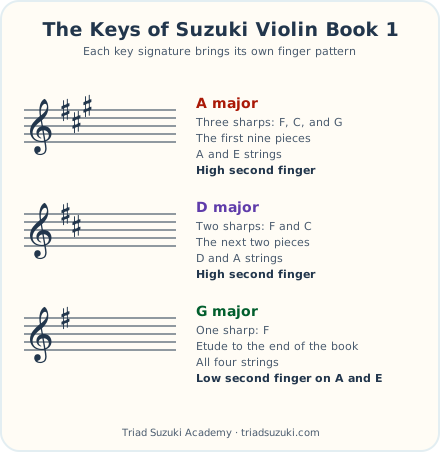
On violin and viola, it also tells you where your fingers go. This guide shows how to read a key signature, and how the first Suzuki book uses keys to keep a beginner's left hand simple.
What a key signature tells you
If the key signature has an F-sharp, every F you play is F-sharp, in every octave, with no sharp written beside the note. A note that is not in the key signature is played natural, unless a sign beside it says otherwise.
Read it before the first note, the way you read the clef and the time signature.
Sharps and flats come in a fixed order
Sharps are always added in the same order: F, C, G, D, A, E, B. One sharp is always F-sharp, two sharps are always F-sharp and C-sharp, and so on down the list. A classic phrase helps: Father Charles Goes Down And Ends Battle.
Flats follow the same letters in reverse: B, E, A, D, G, C, F. The first four spell BEAD.
How to name the key
- With sharps, go up a half step from the last sharp. Three sharps end on G-sharp, and a half step up is A, so three sharps is A major.
- With flats, the second-to-last flat names the key. Three flats are B-flat, E-flat, and A-flat, so three flats is E-flat major.
- Two to memorize: no sharps or flats is C major, and one flat is F major.
| Key | Key signature | Notes it changes |
|---|---|---|
| C major | None | None |
| G major | One sharp | F-sharp |
| D major | Two sharps | F-sharp, C-sharp |
| A major | Three sharps | F-sharp, C-sharp, G-sharp |
| F major | One flat | B-flat |
| B-flat major | Two flats | B-flat, E-flat |
Each key signature also fits a minor key, three half steps below the major one. One sharp can mean G major or E minor. To tell which, look at where the piece begins and ends.
The circle of fifths
The circle of fifths puts every key signature in one picture. From C at the top, each step clockwise is a fifth higher and adds a sharp, and each step counterclockwise adds a flat. The keys at the bottom have two names, one from each side. Inside each major key is the minor key that shares its key signature.
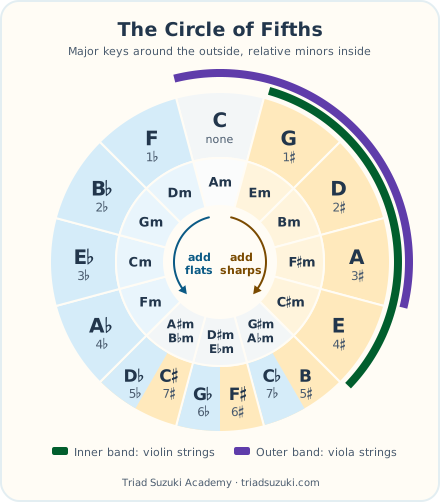
A violin's strings are a fifth apart, so G, D, A, and E sit side by side on the circle. A viola's strings, C, G, D, and A, sit one step counterclockwise. The three keys of Suzuki Violin Book 1, A, D, and G, are neighbors too. To learn the circle by heart, try our free Circle of Fifths class and game.
What it means for your fingers
On a violin or viola, notes a half step apart are played with fingers close together, and notes a whole step apart leave a space between them. The key signature tells you where those half steps fall, so it shows the shape of your hand on each string.
Teachers have short names for these shapes. With a high second finger, the second finger sits close to the third. With a low second finger, it sits close to the first.
How Suzuki Book 1 uses this
Suzuki Violin Book 1 uses only three keys, and a University of Cincinnati doctoral study (opens in a new tab) of the book describes the choice of keys as closely related to the finger patterns.
- A major. The first nine pieces, through Perpetual Motion, stay on the A and E strings, so one pattern, the high second finger, plays them all.
- D major. Allegretto and Andantino move to the D and A strings and keep the high second finger.
- G major. Etude and the pieces after it bring in the low second finger on the A and E strings.
The key signature shows why. A major and D major both have C-sharp, so on the A string the second finger stays high. G major has only F-sharp, so C is natural and the second finger moves back, close to the first. Etude is also the first piece in the book on all four strings, which is one reason to practice the new pattern before reaching it.
On the viola
The viola is tuned a fifth lower than the violin, and the Suzuki viola books are adapted from the violin books and written a fifth lower. So a viola student uses the same finger patterns on the matching strings, in a key a fifth lower. The A major pieces in Violin Book 1 are in D major in Viola Book 1.
Violists read the alto clef, so the sharps and flats sit on different lines and spaces than they do in the treble clef. The order is the same, and so are the ways of naming the key.
Practice reading them
Our free Key Signatures class goes through all of this one step at a time, and the key signature quiz lets you practice naming keys. If you have questions about reading music or starting lessons, we are happy to talk. You can also book a free trial lesson.
Sources
- Major Key Signatures (opens in a new tab) and Minor Key Signatures (opens in a new tab), Music Theory for the 21st-Century Classroom, Robert Hutchinson, University of Puget Sound