
My Music Theory Workbook
Printable pages for students who already read music: rhythm and meter, scales and key signatures, intervals, chords and cadences, and reading a score, with an answer key.
32 pages · US Letter · PDF, 0.7 MB. Free, with no email or sign-up.
Print makes the workbook alone, the same as the PDF. Your browser’s print window can also save it as a PDF.
To print the workbook itself, use the Print the workbook button on this page, or download the PDF.
A look inside
The cover, page 1 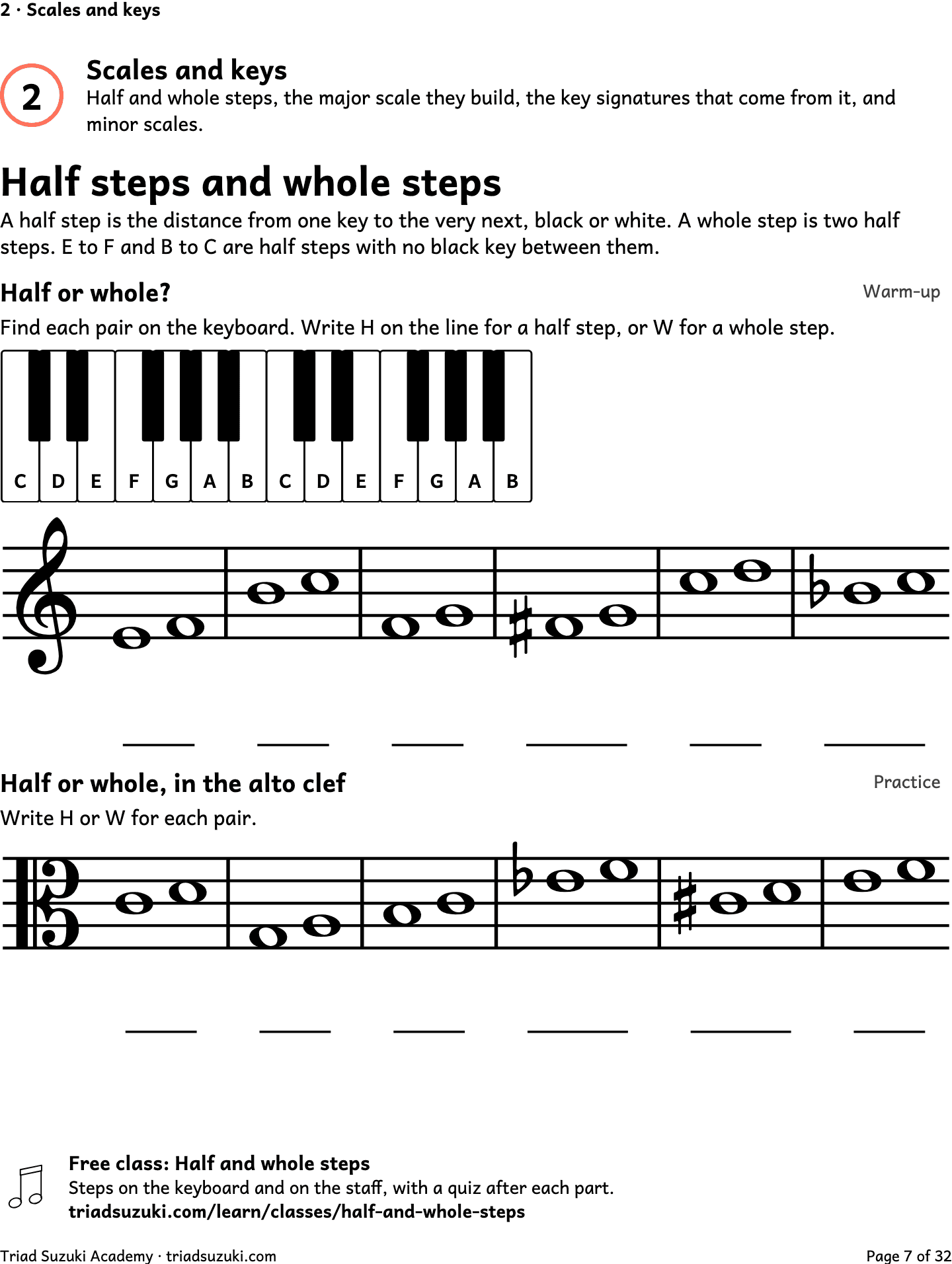
Section 2: half and whole steps, page 7 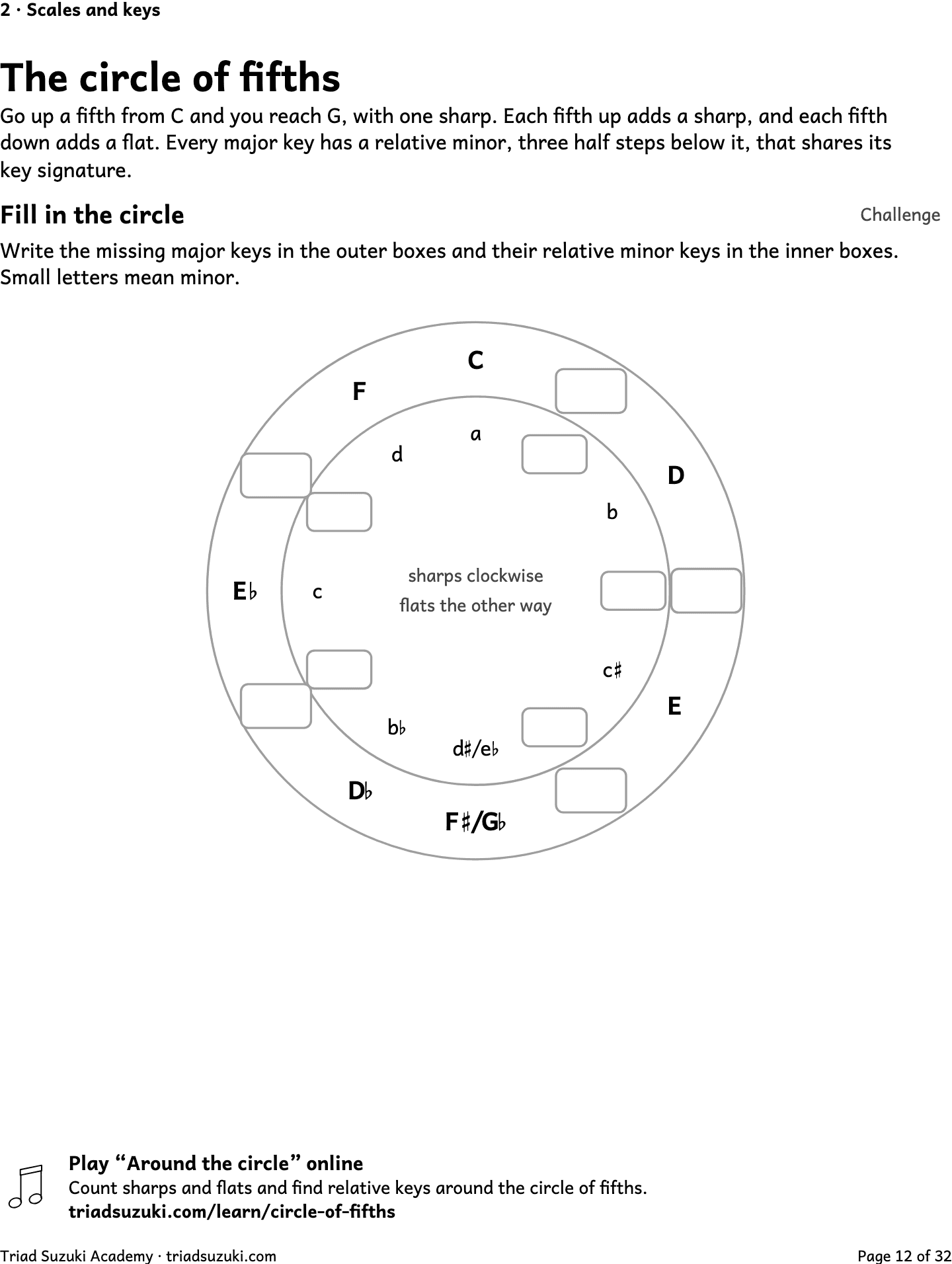
Section 2: the circle of fifths, page 12 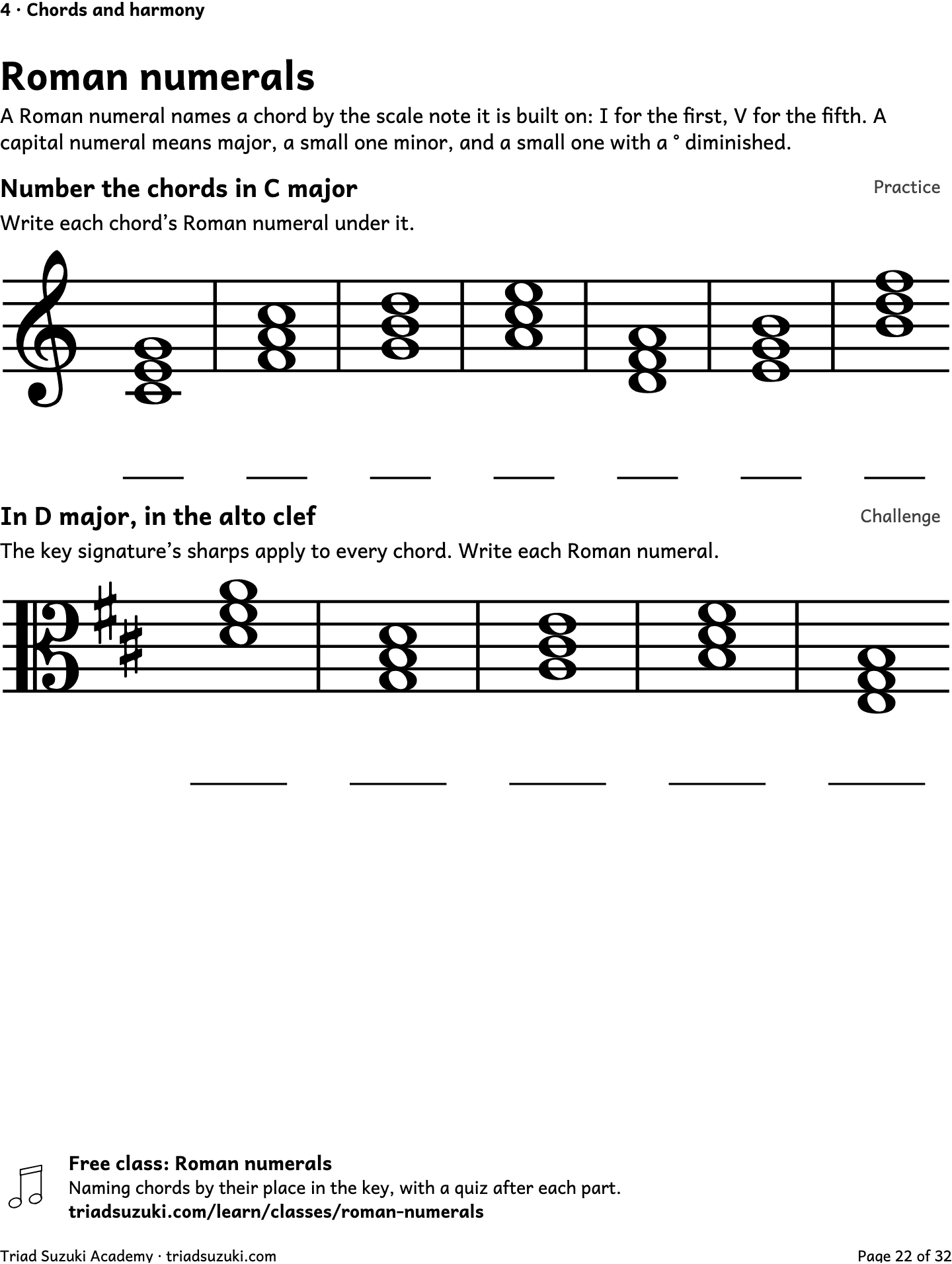
Section 4: Roman numerals, page 22
What is inside
- 1. Rhythm and meter (pages 3 to 6). How beats group into measures, and how to count any rhythm out loud in numbers.
- 2. Scales and keys (pages 7 to 13). Half and whole steps, the major scale they build, the key signatures that come from it, and minor scales.
- 3. Intervals (pages 14 to 18). The distance between two notes: its number, from counting letters, and its quality, from counting half steps.
- 4. Chords and harmony (pages 19 to 24). Triads, the chords built from stacked thirds, and how they move in a key: Roman numerals and cadences.
- 5. Reading a score (pages 25 to 27). The bass clef, the words and signs on the page, and how a piece is put together.
It ends with an answer key and a page to celebrate. Download all 32 pages.
Who it is for
Violin and viola students from about ten years old to adult who already read music and are ready to learn how it works.
Violinists read the treble clef pages first and violists the alto clef pages, and the last section adds the bass clef for reading a full score.
Each activity is marked warm-up, practice, or challenge, so a student can start where they are. The answers are at the back.
Free online classes and games to go with it
Every page of the workbook names a free class or game on our site that teaches or practices the same thing. They work on a phone, tablet, or computer, with nothing to sign up for.
Free class · Section 1
Time Signatures
Read the two numbers at the start of a piece: what each one counts, common time, and the simple and compound meter families.
Free class · Section 1
Ties & Slurs
Two curves that look alike: the tie that holds a note longer, and the slur that connects notes smoothly.
Free game · Section 1
Count the beats
Count the beats in a measure and name its time signature. From a steady 4/4 to a lilting 6/8.
Free class · Section 2
Half & Whole Steps
Half steps and whole steps on the keyboard, and the two natural half steps hiding among the white keys.
Free class · Section 2
The Major Scale
The whole and half step pattern that defines major, how to build it on any note, and the scale degrees that give it its bright pull home.
Free class · Section 2
Key Signatures
The sharps or flats after the clef: the fixed orders, naming the key at a glance, and the relative-minor pair every signature holds.
Free game · Section 2
Key signature quiz
How many sharps or flats, and which key is it? Learn to read a key signature at a glance.
Free game · Section 2
Around the circle
A key appears and you answer a question about it: how many sharps or flats, the relative key, or the neighbor a fifth away.
Free class · Section 2
Minor Scales & Modes
The darker minor scale, its relative-minor link to major, the three minor forms, and the seven modes as rotations of one collection.
Free class · Section 3
Intervals
Measure the distance between two notes: counting the number, steps and skips, the family up to the octave, and melodic versus harmonic.
Free class · Section 3
Interval Quality
Name an interval's exact size: perfect, major, and minor, counting half steps, the major-scale shortcut, and augmented and diminished.
Free game · Section 3
Name that interval
Two notes appear on the staff and you name the distance between them. From a second up to a full octave.
Free game · Section 4
Name that chord
A chord appears stacked on the staff and you name its quality. Major and minor to start, then diminished, augmented, and seventh chords.
Free class · Section 4
Triads & Seventh Chords
How chords are built: three notes stacked in thirds, the four triad qualities, and the seventh chords that add one more third on top.
Free class · Section 4
Roman Numerals
Labeling chords by scale degree and quality: I ii iii IV V vi vii, uppercase and lowercase, and the function families that drive tonal harmony.
Free class · Section 4
Cadences
The harmonic punctuation that ends phrases: the authentic, half, plagal, and deceptive cadences and the different closes they make.
Free class · Section 5
Bass Clef
Learn to read the bass clef from scratch: the F line, lines and spaces, reading on sight, and handy mnemonics.
Free game · Section 5
What does it mean?
A musical marking appears and you pick what it means, from tempo and dynamics to string playing and expression.
Free class · Section 5
Binary & Ternary Form
The sectional forms: binary (AB) and ternary (ABA), rounded binary, and how to tell them apart by section and key.
Lessons in Kernersville
Theory makes more sense with an instrument in your hands. Book a free 30-minute trial lesson at our studio in Kernersville, North Carolina, at the heart of the Triad.